3D Manufacturing Explorations
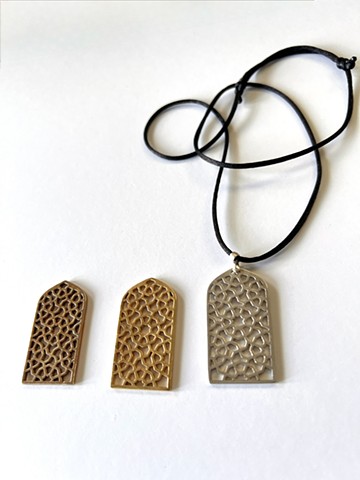
I have long been drawn to the geometric patterns of carved screens in Islamic art and to the shifting shadows cast by sunlight passing through them at different times of day. The way light, geometry, and time interact across these surfaces creates a quiet, contemplative beauty. This enduring fascination became the starting point for the Soul Window series of pendant and earring designs.
Carved lattice screens, known as mashrabiyya in Arabic and jali in Urdu, are traditionally made from wood or stone. They serve multiple purposes: allowing air circulation, providing privacy, and creating intricate visual effects through light and shadow. Beyond their functional role, these screens are celebrated for their rich ornamental language and rhythmic geometry.
A key element of Islamic decorative tradition is the arabesque, an intricate system of interlacing vegetal and geometric forms. Unlike European pictorial traditions, which often rely on triangular or perspectival composition, Islamic design tends toward flowing, S-shaped, and swirling structures. These continuous lines generate layered patterns in which smaller, detailed motifs emerge within larger rhythmic frameworks.
While the Qur’an does not explicitly prohibit figural representation, restrictions on depicting humans and animals are commonly derived from interpretations of hadith, recorded sayings attributed to the Prophet Muhammad. This interpretive tradition encouraged many artists and patrons to explore abstraction as a primary mode of expression. As a result, the arabesque became a vital and expressive visual language, allowing for spiritual reflection through pattern, repetition, and geometry rather than figuration.
The Soul Window pieces translate these architectural and ornamental principles into wearable form, carrying forward the interplay of light, shadow, geometry, and contemplation found in carved screens.
Source
Prasertwaitaya, Leila (2007). Untangling the Arabesque: Islamic Design Elements in the Monroe Park Campus. Department of Art History, Virginia Commonwealth University.